5 Signs Your Payson AZ Home Has a Sewer or Drain Problem That Won't Fix Itself
Most drain problems look simple from the outside. A slow drain. A gurgling toilet. A smell that comes and goes. The temptation is to pour something down the drain, plunge it, or wait for it to pass.
Some drain problems do pass. Localized clogs from hair, soap buildup, or minor debris clear with basic intervention and stay clear. But there is a specific category of sewer and drain problem that does not work that way. It clears temporarily and comes back. It gets a little worse each time. And by the time the homeowner realizes the fix they have been applying is not actually fixing anything, the scope of the problem has grown significantly.
Doug Hall's Plumbing Services works on sewer and drain systems throughout Payson, Pine, Strawberry, Heber, and the surrounding Rim Country communities. The calls that involve the most extensive and expensive repairs are almost never the ones that started suddenly. They are the ones where the signs were present for months or years and the homeowner kept treating the symptom without addressing the cause.
These are the five signs that a sewer or drain problem in your Payson home is not going to fix itself.
Why Payson Sewer and Drain Problems Develop Differently
Payson sits at approximately 4,900 feet elevation in the Mogollon Rim country. The combination of clay-heavy soils, monsoon-driven soil movement, mature ponderosa pine and oak root systems, and an older housing stock with original clay or cast iron sewer lines creates specific conditions that make drain problems here more likely to be structural rather than surface-level.
| Payson-specific condition | How it affects sewer and drain systems |
|---|---|
| Clay and caliche soil | Shifts during wet and dry cycles, stressing buried pipe joints |
| Monsoon season soil movement | Can create sags or bellies in buried sewer lines where waste pools |
| Mature ponderosa pines and oaks | Root systems extend 20 to 30 feet and actively seek moisture in sewer lines |
| Older Rim Country housing stock | Many homes have original clay or cast iron lines past their service life |
| Arizona hard water minerals | Accelerate interior pipe scale buildup that narrows effective diameter over time |
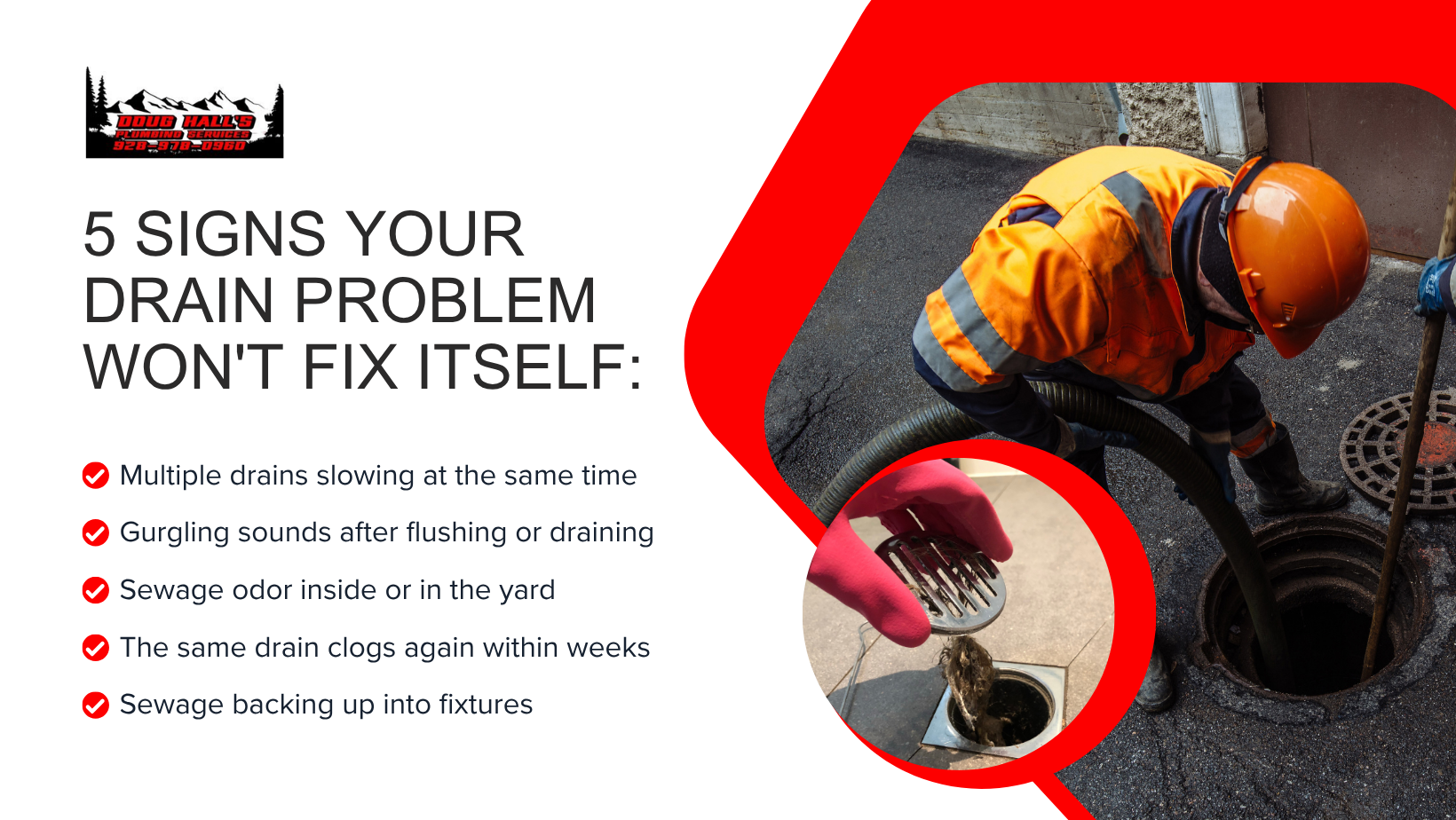
Sign 1: Multiple Drains Are Slow at the Same Time
A single slow drain almost always indicates a localized clog at or near that fixture. Hair in the shower trap, grease in the kitchen P-trap, soap accumulation in the bathroom sink. These are contained problems that a professional drain cleaning at the individual fixture resolves reliably.
When two or more drains across different areas of the home are slow simultaneously, the problem is in the main sewer line that all of them connect to, not in the individual fixtures. According to John's Sewer and Drain's research on tree root intrusion, root growth in a main sewer line gradually restricts the pipe's diameter, making it harder for water to flow through. Multiple fixtures show the effect at the same time because the restriction is downstream from all of them.
In Payson-area homes with mature trees and original clay sewer lines, this is one of the most consistent presentations Doug Hall's Plumbing Services encounters. The homeowner notices the kitchen and bathroom drains both slowing around the same time and assumes it is a coincidence. It is not.
What to do: Do not reach for retail drain cleaning products. Chemical cleaners are designed for localized fixture clogs and do not address main line restrictions. A professional camera inspection of the sewer line is the diagnostic step that identifies what is actually causing the system-wide slowdown before any repair recommendation is made.
Sign 2: Gurgling Sounds After Flushing or Draining
A properly functioning drain system operates silently. Water enters, flows through, and clears without any sound returning through other fixtures. Gurgling means air is being displaced backward through the system rather than moving forward through the vent stack as designed.
According to Any Hour Services' drain clearing research, gurgling sounds indicate that air is trapped or displaced in the drain line, which is a consequence of an existing blockage. When water attempts to flow past a substantial clog, it creates a vacuum that forces air back through the nearest opening.
| Gurgling location | What it likely indicates |
|---|---|
| Toilet gurgles when flushed | Partial restriction downstream in the main drain line |
| Nearby drain gurgles when toilet flushes | Shared drain segment is restricted |
| Floor drain gurgles after heavy fixture use | Main line approaching capacity or restricted |
| Any drain gurgles after water clears | Line below the fixture is not fully open |
In Payson homes, vent stack blockages from pine needle accumulation on the roof are also a documented cause of gurgling. Doug Hall's Plumbing Services checks both the drain line and the vent system when gurgling symptoms are present, because treating a vent blockage like a drain line problem produces the wrong re
Sign 3: The Same Drain Keeps Clogging Within Weeks
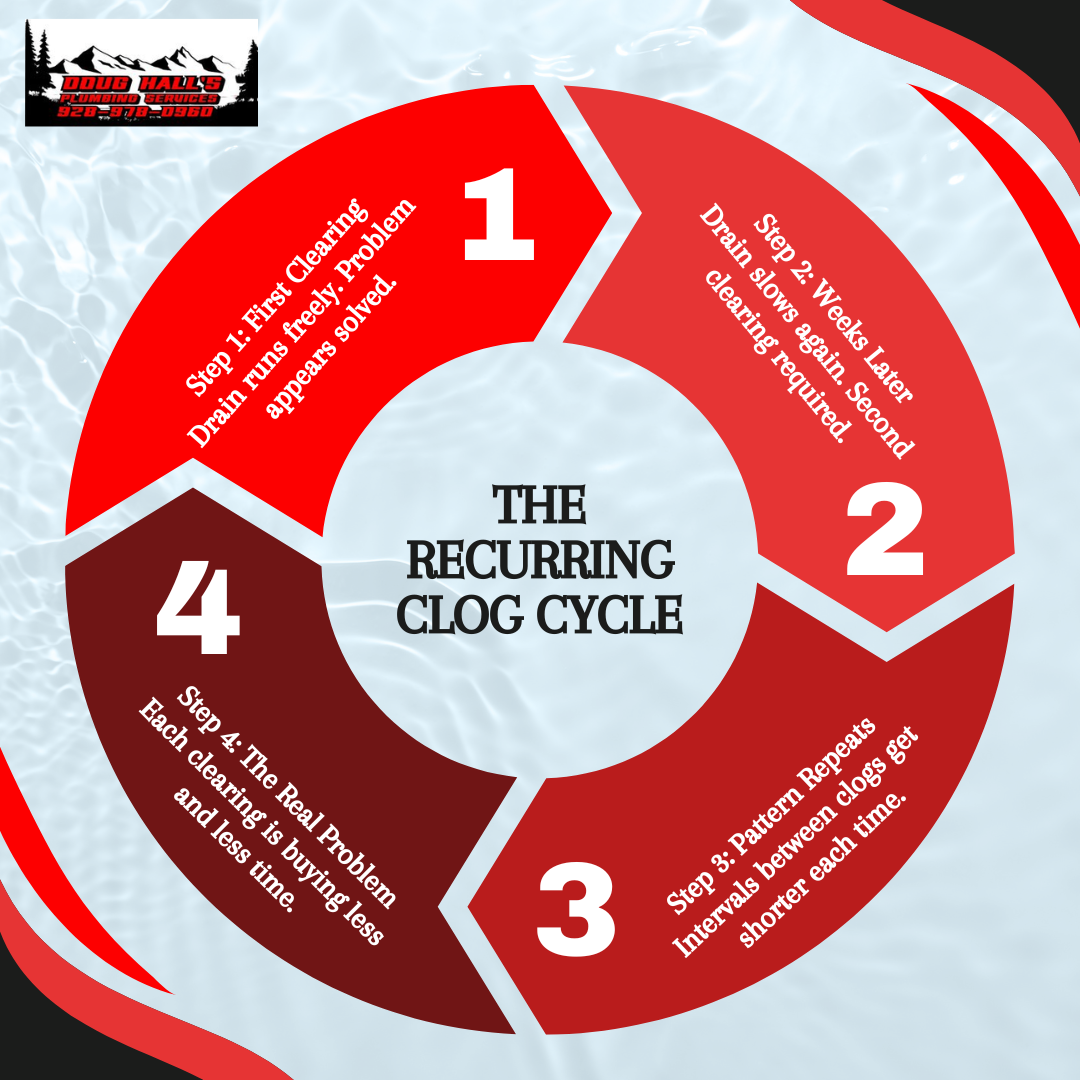
A drain that has been professionally cleared and returns to slow or blocked within a few weeks is not evidence that the clearing did not work. It is evidence that the clearing addressed the symptom while the underlying condition continued developing.
According to John's Sewer's root intrusion research, roots cleared from a sewer line by mechanical cutting return within one to three years without proper pipe repair. They remain in the pipe and resume growth from surviving material. Each subsequent clearing cycle produces shorter relief as the root mass re-establishes faster than before.
The same pattern applies to sewer line bellies, which are documented in Arizona by Penguin Air's drain research as caused by soil erosion from monsoons and shifting ground conditions. A belly creates a low point where waste pools rather than flowing forward. Clearing the blockage that forms there removes the accumulated waste but does not change the slope that caused it to accumulate. The clog returns because the structural condition that produces it has not changed.
The recurring clog cycle Doug Hall's team sees in Payson homes:
| Situation | What to do |
|---|---|
| Single drain slow, clears with plunger | Monitor. If it returns within 2 weeks, call |
| Two or more drains slow simultaneously | Call Doug Hall's for camera inspection |
| Same drain clogged twice in 30 days | Call. Recurring pattern means structural cause |
| Gurgling from multiple fixtures | Call. Vent or main line assessment needed |
| Sewage odor not resolved by refilling traps | Call same day |
| Any sewage backup into fixtures | Call immediately |
| Green or wet patch in yard above sewer line | Call. Below-grade leak confirmed |
A camera inspection converts this cycle from a recurring expense into a confirmed diagnosis. Once the source is visible, the repair is specific: root intrusion treated at the pipe level, a deteriorated section replaced, or a belly section re-graded. The cleared drain stays clear because the cause has been addressed.
Sign 4: Sewage Odor Inside the Home or in the Yard
A properly functioning sewer system is completely sealed from the living space. Every fixture has a P-trap that holds water as a barrier against sewer gas. The vent stack equalizes pressure so those traps stay sealed during drain use. When the system works correctly, no sewer odor enters the home.
Persistent sewage odor that does not resolve after refilling all unused fixture traps indicates one of three conditions, each requiring different professional response:
Vent stack blockage: Pine needles, leaves, and debris common in Payson's forested environment block vent stacks more frequently than in lower-elevation communities. A blocked vent creates negative pressure that siphons P-trap water, allowing sewer gas to enter through fixtures.
Sewer line crack or separation: A cracked or separated line below grade allows sewer gas to escape into the surrounding soil and find pathways into the structure through foundation gaps and utility penetrations. Odor strongest in the lowest level of the home or near foundation walls indicates this source.
Lush or wet patches in the yard: According to Central Plumbing's sewer warning signs research, extra lush or soggy patches along the sewer pipe path from the house to the street indicate the line is leaking below grade. The leaking sewage acts as fertilizer, producing visibly greener or thicker grass directly above the pipe route.
Sewer gas contains hydrogen sulfide, which is hazardous at elevated concentrations per OSHA's hydrogen sulfide guidelines. A sewage odor that persists after refilling all fixture traps is a same-day professional assessment, not a wait-and-see situation.
Sign 5: Sewage Backing Up Into Fixtures
Sewage backup is the sign that the system has moved past gradual restriction and reached a condition where waste has nowhere to go but backward into the home. It is the most urgent sign on this list and the one that requires immediate professional response.
According to Drain and Water's underground plumbing research, recurring clogs, slow drains across multiple fixtures, gurgling toilets, sewer odors, and backups especially after heavy water use all point to structural sewer problems like roots, cracked clay, or a belly. Backup is not the beginning of the problem. It is where a problem that began with one of the earlier signs on this list ends up when it is not addressed.
What backup typically looks like in a Payson home:
- The lowest fixture in the home, a floor drain, ground floor toilet, or utility sink, shows backup first because it is the first point downstream from the main line blockage
- Flushing one toilet causes water to appear in a nearby shower or floor drain
- Sewage odor intensifies significantly when backup occurs
The blockage that produced the backup is still in the main line after the backed-up water recedes. The next significant fixture use pushes the system back to the threshold. The only question is how quickly.
When to Call vs. When to Wait
| Maintenance Task | Why It Matters |
|---|---|
| Flush the Tank | Removes sediment buildup, restores heating efficiency, and eliminates rumbling noises |
| Test the T&P Valve | Ensures the pressure relief valve functions correctly — a critical safety check |
| Inspect the Anode Rod | Especially important in hard water areas — replace if over 75% corroded or under ½ inch thick |
| Check Connections & Lines | Inspects for rust, leaks, and freeze stress damage on supply lines and fittings |
| Verify Efficiency | Confirms proper burner combustion on gas units or heating element function on electric units |
| Full Leak & Rust Inspection | Complete inspection of tank exterior and base for any signs of corrosion or moisture |
What the Diagnostic Process Looks Like
Doug Hall's Plumbing Services uses camera inspection for any situation where a drain problem shows signs of being structural rather than surface-level. The camera travels through the line and provides a direct view of what is causing the problem: root mass, pipe deterioration, a belly section, a joint separation, or a combination of conditions.
This eliminates guesswork. The repair recommended after a camera inspection is based on what the line actually shows, not on an assumption about what might be there. For Payson homeowners who have been clearing the same drain repeatedly without lasting relief, a camera inspection is almost always the step that finally produces a real answer.
Frequently Asked Questions
How do I know if my sewer line has tree root intrusion?
The most reliable indicator is a drain that clears and returns repeatedly, particularly if the home has mature trees within 20 to 30 feet of the sewer line path. Camera inspection confirms root intrusion and shows the extent before any repair is recommended.
Can chemical drain cleaners clear a main sewer line blockage?
No. Chemical drain cleaners are formulated for localized fixture clogs involving organic material. They do not remove root intrusions, repair sagging pipe sections, or address structural deterioration. Using them repeatedly on a main line problem delays the professional diagnosis that would identify the real cause.
How long does a camera inspection take?
Most residential sewer camera inspections take 30 to 60 minutes. The findings are visible in real time and Doug Hall's team explains what the camera shows before making any repair recommendation.
Are clay sewer pipes in older Payson homes a serious concern?
Yes. Clay pipes were common in Arizona residential construction before PVC became standard and are now past their expected service life in many Rim Country homes. They crack, develop rough interior surfaces that catch debris, and are vulnerable to root intrusion at joints. If your home was built before the late 1970s and you have not had your sewer line inspected, it is worth scheduling one.
Does homeowner insurance cover sewer line problems?
Standard homeowner policies typically do not cover gradual root intrusion damage, which insurers classify as a maintenance issue. Some policies offer optional sewer line coverage. Doug Hall's Plumbing Services recommends reviewing your specific policy and keeping a record of any professional sewer maintenance performed.
What is the difference between drain cleaning and sewer repair?
Drain cleaning removes blockages and restores flow. Sewer repair addresses the structural condition that caused the blockage. Both may be needed, but cleaning alone on a structural problem produces temporary results. Doug Hall's team assesses whether cleaning or repair is the appropriate response before any work begins.
If you're experiencing any of these plumbing issues in Payson, Pine, Strawberry, or the surrounding Rim Country communities, Doug Hall's Plumbing Services can inspect the problem, explain your options, and recommend the most practical solution for your home.
Contact Doug Hall's Plumbing |
Sewer and Drain Services |
Plumbing Repairs |
All Services
Recent Posts